Why it matters to recognize how symptoms evolve from teen to adult
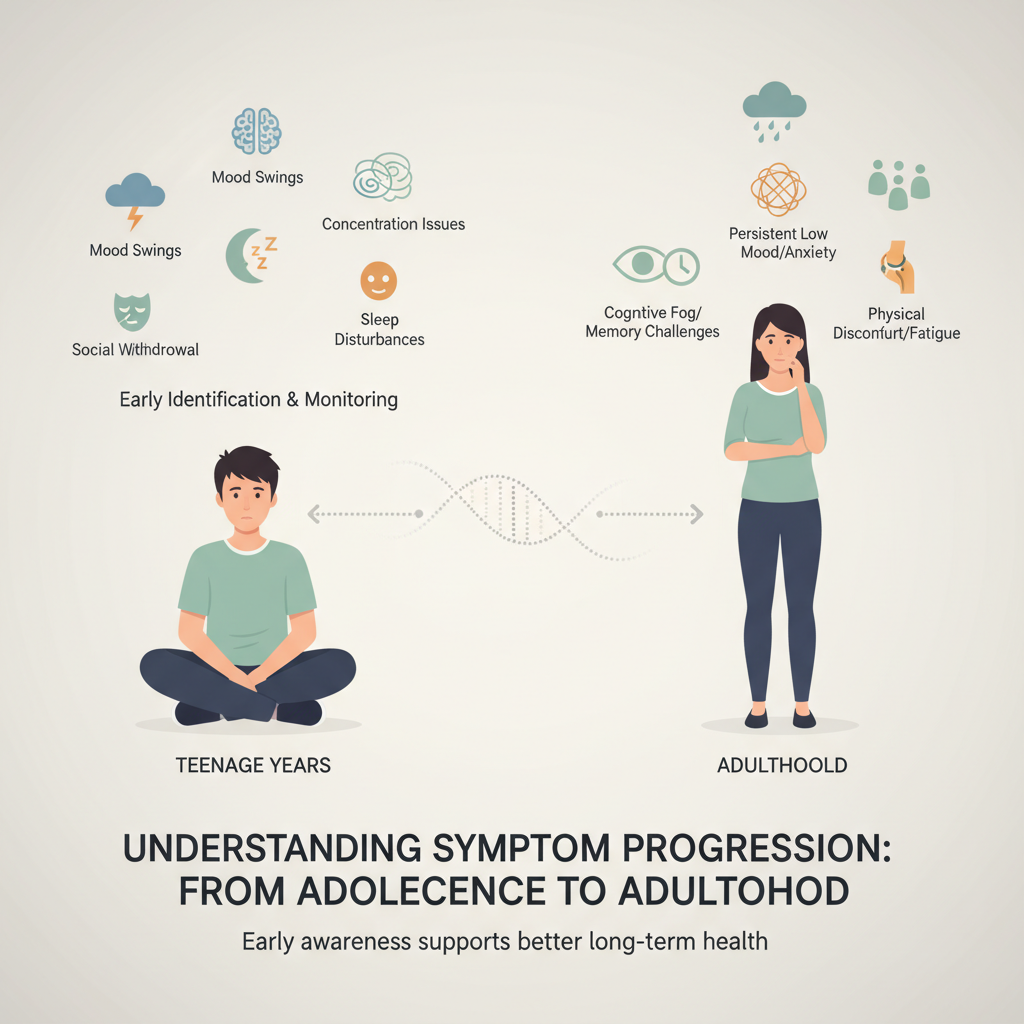
If you want to understand how symptoms evolve from teen to adult, you are already doing something important. You are trying to separate age-typical behavior from early signs of mental health concerns. That distinction is not always obvious. Hormonal shifts, brain development, and social pressures all affect how your teen behaves now, and how those symptoms might look in their twenties.
Researchers have found that many mental health disorders first appear by late adolescence, and that half of all adult mental health disorders begin during the teen years [1]. Understanding the trajectory from teen to adult can help you seek support earlier and adjust expectations as your child matures.
You can use this guide alongside resources on early signs of mental illness in teenagers and adult mental health warning signs to build a clearer picture of what is going on at each age.
How age shapes mental health symptoms
To recognize how symptoms evolve from teen to adult, you first need a sense of what is changing inside your child or young adult.
During adolescence, your teen’s body, hormones, and brain are all in transition. Puberty brings rapid growth, changes in body shape, and the development of secondary sexual characteristics such as breast development in girls and facial hair in boys [2]. Alongside this, brain regions involved in emotion and reward mature earlier than regions responsible for planning and impulse control.
This mismatch helps explain why teens often feel things intensely but struggle to regulate those feelings. Emotional regulation is unstable in adolescence because the limbic system and prefrontal cortex mature at different speeds, which creates a gap between what your teen feels and what they can understand or control [3].
By young adulthood, much of this brain development has progressed. Young adults typically have greater capacity for reflection and long term planning, even if they still make impulsive choices at times. Emotional reactions may become less explosive on the outside but more internalized, showing up as worry, self criticism, or persistent low mood rather than obvious outbursts.
If you want a broader context, you can also review mental health development stages explained to see how these changes unfold across childhood, adolescence, and adulthood.
Emotional symptoms from teen to adult
Emotional signs are often your first clue that something deeper is going on. The challenge is that teen emotions are intense even when everything is typical. Understanding how feelings shift across age can help you tell the difference between development and distress.
Typical teen emotional patterns
Hormonal changes in adolescence contribute to mood swings, irritability, heightened sensitivity, and stronger reactions to social situations [2]. Your teen may move quickly from excitement to despair, especially around friendships, school, or romantic interests.
Research shows that adolescents are particularly sensitive to negative emotional cues. In one study, teens had slower reaction times to fearful facial expressions than to happy ones, suggesting that threatening or negative information captures their attention more powerfully than it does for children or older adults [4].
This heightened sensitivity is part of why everyday setbacks can feel catastrophic to a teenager. However, when emotional intensity becomes constant, overwhelms daily functioning, or comes with other warning signs, it may point toward an emerging mood or anxiety disorder.
For help spotting these patterns, you can look at recognizing emotional distress in teens and when teen behavior is more than normal.
How emotions often look in adults
As your teen moves into early adulthood, the emotional picture can change. Young adults may not show the same level of visible mood swings, but they can experience more persistent internal distress.
The same study that found slower teen reactions to fearful faces also showed that young adults had more variability in their responses to these fearful cues, which may reflect more deliberate processing and top down control of emotions [4]. In everyday life, that can look like:
- Less obvious outbursts
- More rumination and overthinking
- Quiet withdrawal rather than dramatic conflict
Instead of shouting or slamming doors, a distressed young adult might simply stop returning calls, lose motivation, or talk about feeling “stuck” or “numb.” These shifts are one reason mental health symptoms in adults vs adolescents can be easy to miss if you are waiting for the same dramatic signs you saw during the teen years.
Red flags across both stages
At any age, you should pay attention if you notice:
- Persistent sadness or irritability lasting most days for several weeks
- Intense hopelessness or statements that life is not worth living
- Sudden, extreme changes in mood that affect school, work, or relationships
- Emotional reactions that seem far out of proportion to the situation
Resources on warning signs of mood disorders by age can help you compare age typical and concerning patterns more systematically.
Behavioral symptoms from teen to adult
Behavior is often where you first see changes, especially with boys or with teens who tend to act out rather than internalize distress. The difficulty is that adolescence is naturally full of experimentation and boundary testing.
Teen behavioral changes and what they may signal
During adolescence, lifestyle habits tend to shift in less healthy directions. Many teens show declines in diet quality, physical activity, and sleep, along with increased sedentary behavior, smoking, and early substance use [3]. While some of this is common, patterns of behavior can still provide valuable information.
You should watch for:
- Sudden drops in grades or loss of interest in previously important activities
- Social withdrawal or a complete change in friend group
- Persistent conflict with family, teachers, or peers
- Rule breaking, stealing, or frequent lying
- Early or escalating substance use
- Risk taking that goes beyond normal curiosity
Persistent behavioral changes, especially when combined with shifts in sleep, appetite, or physical complaints, may indicate underlying health or mental health conditions [2].
To dig deeper into patterns like these, explore behavioral changes in teenage mental health and how to recognize mental health issues in teens.
How similar issues can evolve in adulthood
Many behavior patterns that first emerge in adolescence either settle, transform, or intensify in adulthood. A South Wales study following teens moving from child to adult mental health services found that 76 percent had changes in diagnosis after transition, with many adolescent conditions evolving into different adult disorders [5].
Externalizing behaviors in teens, such as aggression or rule breaking, often remained but took adult forms. Some adolescents with externalizing disorders later met criteria for adult dissocial or antisocial personality disorders [5]. In daily life, what once looked like school fights or shoplifting can turn into:
- Repeated job loss due to conflict or disregard for rules
- Legal problems, assaults, or driving under the influence
- Chronic relationship turmoil and verbal or physical aggression
Substance use can also progress. Global data show that more than a quarter of people aged 15 to 19 drink alcohol, with a significant proportion engaging in heavy episodic drinking. Cannabis and other substances are also common in this age group [1]. For some, experimental use fades. For others, it becomes regular misuse or dependence in adulthood, with consequences for work, health, and relationships.
You can find a fuller breakdown of transitions like these in mental health red flags in young adults and signs of serious mental illness in adults.
Cognitive symptoms and thought patterns by age
Cognitive symptoms include changes in attention, memory, decision making, and thought content. These can be subtle, but they are important signals when you want to understand how symptoms evolve from teen to adult.
How thinking develops during adolescence
During adolescence, brain areas responsible for planning, impulse control, and complex decision making are still maturing. Cognitive functions like executive functioning remain relatively immature, which contributes to a gap between emotion, cognition, and behavior [3]. Your teen might know the right choice in the abstract but struggle to follow through when emotions are high.
Common cognitive signs to watch for include:
- Difficulty concentrating on schoolwork that is new, long, or boring
- Black and white thinking about friendships or self worth
- Strong belief that “nobody understands” or “things will never change”
- Persistent worry about peer judgment or social status
While some of this is typical, more severe or persistent patterns can signal anxiety disorders, depression, or emerging thought disorders. The resource how age impacts mental health symptoms can help you place these patterns in context.
Cognitive changes in young adulthood
By early adulthood, many people show stronger executive function and more nuanced thinking. At the same time, pressures around education, work, finances, and relationships can increase cognitive load.
In young adults, you might see:
- Persistent indecision or an inability to make basic life choices
- Intrusive, repetitive thoughts about fears or mistakes
- Ongoing difficulty focusing, not just boredom with a specific task
- Suspiciousness, odd beliefs, or detachment from reality in more severe cases
Significant changes in thinking, particularly if they emerge in late adolescence and early adulthood, should be taken seriously. The South Wales study noted that some individuals initially diagnosed with emotional or externalizing difficulties later developed bipolar disorder or schizophrenia as adults [5]. Early evaluation is critical if you observe shifts in reality testing, unusual beliefs, or dramatic changes in functioning.
Anxiety from teen years into adulthood
Anxiety is one of the most common mental health concerns during adolescence and early adulthood. However, the way it presents can change over time.
In teens, anxiety may look like:
- School refusal or frequent complaints of stomachaches and headaches
- Intense fear of embarrassment or humiliation in social settings
- Perfectionism around grades or sports
- Anger or irritability when faced with demands
Hormonal and brain based changes amplify social sensitivity in adolescence, which can make peer interactions feel particularly threatening or high stakes [3].
In adults, anxiety often becomes more tied to work, finances, health, and long term responsibilities. You might notice:
- Constant worry about performance or being fired
- Difficulty relaxing even during downtime
- Avoidance of tasks that require sustained attention or public interaction
- Increased use of substances to manage tension
If you want more detail on these differences, see how anxiety shows up differently in teens and early mental health symptoms in young adults.
Depression and mood disorders over time
Depression and related mood disorders frequently begin in the teen years, but they can look different in adolescents compared to adults.
Teens with depression often show:
- Irritability or anger more than visible sadness
- Social withdrawal, staying in their room, or dropping activities
- Changes in sleep and appetite
- Declining school performance
- Increased sensitivity to rejection or criticism
By adulthood, depression is more likely to appear as:
- Persistent low mood or emptiness
- Loss of pleasure in most activities
- Fatigue and low motivation
- Feelings of worthlessness or excessive guilt
- Physical complaints without clear medical cause
Long term studies show that some adolescent mood disorders remain similar in adulthood, while others progress to more severe conditions. For example, a small number of adolescents with depression later developed bipolar disorder in adulthood [5].
For a structured comparison, you can review depression symptoms in teens vs adults and difference between teen and adult mental health symptoms.
Emotional dysregulation and personality outcomes
Some young people struggle not only with specific episodes of distress but with chronic difficulty managing emotions and relationships. Over time, these patterns can evolve into adult personality disorders.
In adolescence, emotional dysregulation may include:
- Intense, rapidly shifting moods
- Self harm or suicidal talk after conflicts
- Stormy relationships that cycle between idealization and devaluation
- Identity confusion and chronic feelings of emptiness
A study tracking teens into adult mental health services found that many adolescents with eating disorders or significant emotional difficulties later met criteria for emotionally unstable personality disorder (also called borderline personality disorder) as adults [5].
This does not mean that every emotionally intense teen will develop a personality disorder. It does mean that early support with emotion regulation, coping skills, and relational patterns can make a meaningful difference. The article emotional dysregulation in teens vs adults can help you understand these trajectories in more detail.
Physical health and risk behaviors as clues
Mental health symptoms are closely tied to physical health and risk behaviors, and these connections evolve from adolescence to adulthood.
During adolescence you may see:
- Rapid weight changes or disordered eating patterns
- Persistent unexplained physical complaints
- Changes in sleep patterns or chronic sleep deprivation
- Early experimentation with smoking, alcohol, or drugs
Persistent physical symptoms or abnormal sleep patterns in teenagers can signal underlying emotional or medical issues that warrant evaluation [2].
As your child enters young adulthood, risks often shift. Mortality rates are lowest at ages 10 to 14, but increase in young adults aged 20 to 24, with causes of death shifting from infections to accidents, injuries, self harm, and interpersonal violence [1]. This pattern reflects the interaction between mental health, substance use, and high risk behavior in late adolescence and early adulthood.
Lifestyle patterns also become more important. Longitudinal research shows that health lifestyles across adolescence, early adulthood, and young adulthood are diverse and often mixed, rather than consistently healthy or unhealthy. Only a minority maintain consistently positive health lifestyles at any stage [6]. These patterns affect both mental and physical health over time.
Putting it together: Teen vs adult symptom patterns
The table below summarizes some of the key ways symptoms tend to shift from adolescence into young adulthood. This can help you organize what you are seeing.
| Domain | Common in teens | Common in young adults |
|---|---|---|
| Emotions | Rapid mood swings, visible outbursts, intense reactions to peers | More internalized distress, rumination, persistent low mood or anxiety |
| Behavior | School refusal, family conflict, risk taking, early substance use | Work or college problems, relationship instability, ongoing substance misuse |
| Thinking | Black and white thinking, strong peer focus, impulsive decisions | More complex worry about future, job, finances, or long term role |
| Social | Shifts in friend groups, sensitivity to rejection, online conflicts | Isolation, unstable romantic relationships, difficulty maintaining support |
| Physical / lifestyle | Sleep swings, appetite changes, somatic complaints, experimentation | Chronic poor sleep, entrenched habits, higher injury or accident risk |
For a more detailed breakdown of each age group, you can read teen mental health vs adult mental health differences and identifying mental illness across age groups.
How to use this knowledge and when to seek help
Knowing how symptoms evolve from teen to adult gives you a framework. It does not replace professional assessment. Your role is to notice patterns across time, take your concerns seriously, and invite support.
You can start by:
-
Tracking duration and impact
Notice how long emotional, behavioral, or cognitive changes last and how much they interfere with school, work, or relationships. Short term spikes around major stressors are common. Persistent patterns over weeks or months are more concerning. -
Comparing across ages
Ask yourself whether current symptoms are a new version of something you saw earlier or a completely new pattern. A shy teen who becomes a socially avoidant adult with panic may be following one trajectory. A previously confident teen who suddenly becomes paranoid and withdrawn in their twenties may be on another. -
Looking at the whole picture
Consider emotional, behavioral, cognitive, physical, and social changes together. A single symptom rarely tells the full story. Combined patterns are more informative and can be compared with resources like how age impacts mental health symptoms. -
Reaching out early
If you see multiple red flags, or you feel uneasy about what you are noticing, it is appropriate to seek a professional evaluation. Early intervention can change long term outcomes, especially for mood disorders, anxiety, and emerging psychosis.
Mental health symptoms do not appear in isolation. They evolve alongside physical development, brain maturation, and life experience. By paying attention to how signs shift from the teen years into adulthood, you give yourself the best chance to respond thoughtfully, seek the right kind of help, and support your child or young adult through each stage of their mental health journey.